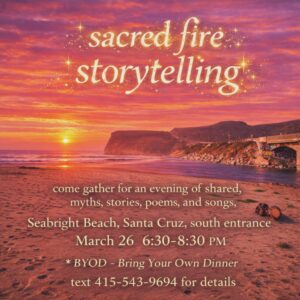
Please join us for Ostara Sacred Fire Storytelling March 26 at 6:30 pm Seabright Beach
As the wheel of the year turns, we arrive at the Vernal Equinox – a fleeting moment of perfect equilibrium where light and dark stand in equal measure across the earth. For millennia, our ancestors observed this threshold. Whether celebrated as the awakening of the dawn goddess Ostara, the sacred resurrection of Easter, or the simple, undeniable triumph of spring over winter, this is a universal season of profound rebirth. Just as the dormant seed pushes through the dark soil toward the warming sun, we invite you to ask yourself: What is awakening within you? What intentions are ready to blossom in this returning light? Join us for a communal feast and gathering to honor the returning light. Bring your hopes, your stories, and a dish to share as we celebrate the resilience of life and the deep rhythms of the earth we inhabit together.
Spring Equinox: Synthesizing Ostara, Christian Resurrection Mythos, and Cosmic Renewal
Thematic Architecture of the March Sacred Fire
The vernal equinox represents one of the most profound astronomical, psychological, and cultural thresholds of the solar year. Marking the precise moment when the sun crosses the celestial equator, this celestial event establishes a fleeting, perfect equilibrium between daylight and darkness before the northern hemisphere tilts inevitably toward the accelerating light of summer.1 Across millennia, this transition has catalyzed complex mythologies, deeply embedded agricultural rituals, and pervasive theological narratives centered on the concepts of rebirth, cosmic renewal, and the triumph of life over dormancy.2
For community organizers and cultural facilitators tasked with convening an event during this period – specifically when crafting an invitation that seeks to unify highly participatory, eclectically spiritual micro-communities – the central challenge lies in harmonizing seemingly disparate traditions into a cohesive, inviting narrative. The modern conceptualization of the spring festival is a dense, historical palimpsest. It layers ancient Indo-European dawn goddess worship, Germanic pagan traditions of Ostara, and the central Christian narrative of the resurrection of Jesus Christ into a single seasonal moment.5
This comprehensive Pastor’s Letter provides a structural, historical, and rhetorical blueprint for designing a community invitation and event architecture that bridges these domains. By deconstructing the historical realities of the dawn goddess Eostre, analyzing the progressive Christian and esoteric dimensions of the Easter narrative, and grounding these concepts within specific local communication ecosystems, this analysis establishes a foundation for a deeply resonant spring gathering. The strategic objective is to formulate a communal experience that honors the sacred roots of multiple traditions, inviting participants to witness the resurrection of the natural world without alienating secular, pagan, or Christian demographics.
The Astronomical and Psychological Foundation of the Equinox
Before addressing the specific religious mythologies that populate the month of March, the framework for the Sacred Fire must be grounded in the astronomical reality of the equinox itself. The term equinox is derived from the Latin words aequus (meaning equal) and nox (meaning night).7 Typically falling between March 19 and March 23 in the Northern Hemisphere, this event marks the precise zenith when the sun is perfectly aligned with the equator, ensuring that day and night are almost exactly equal in length across the globe.1
In various spiritual disciplines, including Benedictine monasticism, the brief balance of the cosmos is viewed as a direct mirror for the internal equilibrium sought in daily human life.3 Benedictine spirituality emphasizes finding a unity among opposing energies—holding longings and fears together, and recognizing the human experience as a continuous dance between dark and light.3 This concept of “Benedictine awareness” requires a humble admission of human limitation while seeking harmony with the deep rhythms of the universe, which include patterns of expansion, contraction, release, and renewal.3
During the vernal equinox, darkness and light are held in perfect suspension, serving as a reminder that the natural world operates on a cyclical balance.3 This natural equilibrium makes the equinox an ideal conceptual anchor for a community gathering. It offers a secular, observable reality that supports broader themes of reflection, gratitude, and the setting of seasonal intentions.4 Framing an event invitation around this “moment of balance” provides an inclusive, unassailable entry point for participants of all belief systems. It acknowledges that the natural world is waking up from its winter slumber, and by extension, invites the community to awaken its own collective potential and creativity.
Unearthing Ostara: The Deep History and Mythology of the Dawn Goddess
A central component of framing an inclusive March event involves respectfully integrating the traditions of Ostara. However, the history of this pagan holiday is frequently misunderstood, heavily layered with nineteenth-century romanticism, and subject to intense scholarly debate regarding its primary sources.2 Crafting an informed community narrative requires distinguishing between historical fact, linguistic reconstruction, and modern neo-pagan folklore, allowing us to present a narrative that is both academically grounded and spiritually resonant.
The primary historical anchor for the existence of the goddess Eostre (alternatively spelled Ostara) is found in the writings of the eighth-century English monk known as the Venerable Bede.1 In his treatise De Temporum Ratione (The Reckoning of Time, authored around 725 CE), Bede noted that the Anglo-Saxon month of April was known as Eosturmonath, named after a goddess named Ēostre.1 According to Bede’s historical account, pagan feasts held in her honor during this month were eventually absorbed into the Christian celebration of the resurrection. As Christianity spread, the joys of the new Christian festival were deliberately called by the “time-honored name of the old observance,” effectively transferring the cultural weight of the goddess to the celebration of Jesus.6
For centuries, modern scholars debated whether Bede had simply invented the goddess Ēostre to explain the etymology of the month’s name, given the lack of corroborating Norse or Germanic texts.1 However, modern historical linguistics and archaeological discoveries have provided significant, compounding support for her historical veneration. Linguistically, the name derives from the Proto-Germanic root austrōn (meaning “dawn”) and the deeper Proto-Indo-European root h₂ews- (meaning “to shine” or “dawn”).6 This etymological lineage places Ēostre within a vast, cross-cultural network of ancient Indo-European dawn goddesses, linking her conceptually to the Greek deity Eos, the Roman goddess Aurora, and the Vedic Hindu goddess Uṣás.6 In the context of an event invitation, invoking Ostara is not merely referencing a localized woodland spirit; it is invoking an ancient, transcontinental human archetype of the returning light.
In 1835, the prominent folklorist and philologist Jacob Grimm expanded significantly on Bede’s foundational account in his seminal work Teutonic Mythology.6 Utilizing Old High German linguistic evidence, Grimm reconstructed the Germanic equivalent of the Anglo-Saxon goddess as Ôstarâ, identifying her as the “divinity of the radiant dawn”.6 Grimm theorized that the worship of this specific dawn goddess was so deeply ingrained in the Germanic psyche that the early Christian church recognized the futility of eradicating her memory, choosing instead to retain her name for their highest holy day in English and German-speaking regions.
Physical archaeological evidence further bolsters the existence of a Germanic spring and dawn cult. In 1958, an extraordinary discovery was made near Morken-Harff, in the vicinity of Bonn, Germany.6 Archaeologists uncovered over 150 Romano-Germanic votive inscriptions dating to approximately 150–250 CE. These stone altars were dedicated to the Matronae Austriahenae, a triad of divine mother goddesses.6 The linguistic stem austri- in their title serves as a direct cognate to the Old English Ēostre, providing physical, epigraphic evidence of a divine feminine cult connected to renewal and dawn in the precise geographic regions associated with the roots of the Ostara tradition.6
| Historical Evidence | Source Material | Relevance to the Ostara Tradition |
| De Temporum Ratione (725 CE) | The Venerable Bede | First written record linking the month of April (Eosturmonath) to the worship of the goddess Ēostre and the subsequent adoption of her name for the Christian Paschal season.1 |
| Teutonic Mythology (1835) | Jacob Grimm | Reconstructed the goddess as Ôstarâ using linguistic frameworks, cementing her identity as an Indo-European divinity of the radiant dawn.6 |
| Votive Inscriptions (150–250 CE) | Discovered near Morken-Harff, Germany (1958) | Physical altars dedicated to the Matronae Austriahenae, containing the linguistic stem austri-, proving the worship of dawn/spring goddesses in the Germanic region.6 |
| Proto-Indo-European Roots | Linguistic Reconstruction | Traces the name to h₂ews- (to shine), linking Ostara to Greek Eos, Roman Aurora, and Hindu Uṣás, establishing her as part of a global dawn archetype.6 |
When drafting event materials that invoke this ancient history, organizers must take care to avoid proliferating historical inaccuracies that frequently circulate in digital spaces. A prominent example is the pervasive and erroneous internet claim that the English word “Easter” is a phonetic derivative of the ancient Mesopotamian goddess “Ishtar”.12 Historical and linguistic analyses completely invalidate this claim. Ishtar was an Akkadian deity of war and sexual love worshiped two millennia before the emergence of the English language, located 4,000 kilometers away from the British Isles, with absolutely no historical association with the vernal equinox or the Sunday following the first full moon of spring.12
Furthermore, the naming convention of “Easter” is a highly localized phenomenon. In almost every non-Germanic European language, the holiday’s name is derived directly from the Greek word Pascha, which traces its lineage to the Hebrew Pesach (Passover).12 Examples include the French Pâques, the Spanish Pascua, the Italian Pasqua, the Dutch Pasen, and the Russian Paskha.12 The assimilation of the dawn goddess Eostre’s name into the Christian lexicon is an exclusively Anglo-Saxon and Germanic adaptation.9 Understanding this allows the event host to present Ostara not in opposition to Christianity, but as a unique cultural bridge between Northern European pagan veneration of the earth and the incoming Christian narrative.
Theological Intersections: Easter, Jesus, and the Solar Resurrection Mythos
To effectively integrate the Christian Easter narrative into an inclusive, community-wide spring event, we must examine how early Christianity deliberately interwove its theology with the existing cosmic and seasonal realities of the equinox. The Christian story of the resurrection is not merely presented as an isolated historical claim regarding a first-century crucifixion in Roman Judea; over centuries, it was strategically and beautifully aligned with the archetypal themes of rebirth that pre-Christian agricultural societies already venerated.5
The most explicit connection between the Christian resurrection narrative and the natural world is encoded within the liturgical calendar itself. Following debates in the early Church, the Council of Nicaea established that Easter would function as a movable feast, calculated astronomically as the first Sunday following the first full moon that occurs on or after the vernal equinox.3 This astronomical dependency inextricably binds the celebration of Jesus’s resurrection to the natural cycles of the moon and the sun, mirroring the exact mechanisms that dictated pagan fertility festivals. It ensures that the celebration of Easter always aligns dynamically with the returning light and the physical, biological awakening of the earth.13
In the early centuries of the Church, theologians actively connected the life, death, and resurrection of Christ to solar phenomena and the renewal of creation. The Apostle Paul articulated the theological concept of Jesus as the “new Adam” who undid the original sin of the first human, positioning Jesus as the catalyst for a fundamentally new creation.15 Because traditional mythological symbolism across the Mediterranean and European worlds positioned spring as the epoch of ultimate creation, early Christians posited that the Genesis creation of the cosmos occurred at the spring equinox, which was theorized under the Julian calendar to be March 25.15
Consequently, the Church Father Sextus Julius Africanus (c. 160–240 CE) argued a point of profound chronological symmetry: if the universe was created on March 25, then the conception of Jesus (the inauguration of the new creation) must have also occurred on March 25. This specific mathematical and theological calculation led directly to the placement of his birth exactly nine months later on December 25, aligning perfectly with the winter solstice and the Roman festival of Sol Invictus (the Unconquered Sun).15
This potent solar imagery permeates biblical scripture and early Christian iconography, providing a rich thematic vein for a celebration during this time of year. Christians considered Jesus to be the “sun of righteousness” prophesied in Malachi 4:2, a divine figure who would arrive to overthrow the forces of darkness and evil in the world, beautifully mirroring the triumph of the spring equinox over the dark half of the year.15 Mosaics discovered in the pre-fourth-century necropolis under St. Peter’s Basilica in the Vatican vividly depict Christ driving a solar chariot across the sky, wearing a radiate crown, essentially acquiring the visual and mythological traits of a solar hero.15 Referencing the “returning light” simultaneously honors the pagan triumph of the sun and the Christian triumph of the Son, acting as a flawless rhetorical bridge between the secular and the sacred.
Progressive Christian Interpretations and the Reality of Resurrection
For modern progressive Christians, the resurrection is frequently interpreted not just as an isolated historical miracle that occurred two millennia ago, but as a continuous, observable phenomenon woven into the very biological fabric of creation.16 As commentators and naturalists have noted, the season of Lent – a forty-day period of somber introspection, sacrifice, and the contemplation of human mortality – gives way seamlessly to the “reality of resurrection” witnessed in the natural world.3
The physical environment provides the most compelling evidence of this continuous rebirth. As the sun angle rises in March, the signs of life emerging from dormancy become undeniable. Naturalists observing the equinox note the bright red and golden bronze of various willow species, the emergence of ground-hugging green foliage like blue flax, penstemon, yarrow, and aster from beneath the dead leaves of winter, and the budding of aspen catkins.16 The awakening of hibernating bears from their dens and the sudden appearance of over-wintering insects, such as the Milbert’s tortoiseshell butterfly, serve as potent, living reminders of the reality of resurrection.16
Within Benedictine monastic communities, this alignment with nature is codified in the Rule of St. Benedict. The Rule advises that the life of a monk should be a “continuous Lent,” a concept not rooted in perpetual suffering, but in a continuous journey of checking in with one’s spiritual progress and preparing for the ultimate joy and spiritual longing of Easter.3 Benedictine spirituality teaches that nature acts as a practical and sacred gateway to the Divine; the “birds of the air” and the “flowers of the field” demonstrate divine providence, encouraging humans to shed their worries and trust in the renewal of life.3
When framing a Ecommunity event, this progressive theological and ecological lens provides a powerful tool for inclusion.17 Acknowledging Easter within a secular or pagan-leaning environment is highly successful when the resurrection is presented as an icon or a narrative manifestation of the universal truth of rebirth. As noted in historical analyses of Church expansion, Christianity absorbed existing agricultural traditions, reframed them, and positioned Jesus as the “icon of this rebranded story”.5 Recognizing this shared thematic architecture allows organizers to celebrate the “deeper story beneath the branding”—the undeniable triumph of life over death, and the awakening of the self alongside the awakening of the soil.5 The invitation can seamlessly ask congregants: “What is awakening in you? What is ready to blossom?”.17
The Semiotics of Spring: Symbols of the Gathering
The physical symbols associated with both Ostara and Easter are vital tools for establishing the visual, aesthetic, and ritual tone of a community event. These ubiquitous symbols – eggs, hares, and emerging flora – pre-date modern commercialization, possessing deep esoteric and cultural resonance that can be highlighted in the event’s framing.4
The Mythology of the Cosmic Egg
The egg is universally recognized across cultures as the ultimate, perfectly designed symbol of potential, fertility, and new beginnings.4 From a historical perspective, painted and decorated eggs were utilized as offerings to honor the returning sun long before they were associated with the Christian narrative of the empty tomb.5
The motif of the “Cosmic Egg” or “World Egg” spans multiple, geographically diverse Indo-European traditions, representing primordial unity and the limitless potential for creation.6
| Cultural Tradition | The Cosmic Egg Mythology |
| Greek Mythology | The “Orphic Egg” serves as the source from which the primordial hermaphroditic deity Phanes emerges, leading directly to the creation of the gods and the universe.6 |
| Hindu Scripture | The universe is described as a cosmic egg known as “Brahmanda,” from which the creator god Brahma emerges, illustrating a perpetual cycle of cosmic creation and destruction.6 |
| Finnish Mythology | The world is said to have been created from the fragments of a duck’s egg that was laid upon the knee of Ilmatar, the goddess of the air.6 |
| Norse Tradition | While conceptualized as a great void rather than an egg, “Ginnungagap” serves a highly similar mythological role as the primordial source from which all life and matter sprang.6 |
Within early Christianity, the egg became associated with rebirth as early as the first century CE, heavily linked to the iconography of the mythological Phoenix, a bird that cyclically burns and is reborn from an egg in its own ashes.11 During the medieval period in Europe, the consumption of eggs was strictly prohibited during the fast of Lent. Consequently, a common practice emerged in England where children would go door-to-door begging for eggs on the Saturday before Lent began. The eggs that were saved during the forty-day fast were subsequently decorated and handed out as highly anticipated special treats when the fast finally broke on Easter Sunday, cementing their association with the holiday.11
The Hare, the Osterhase, and Folktales of Rebirth
The hare holds a deeply sacred place in spring mythology due to its extraordinary reproductive vigor.14 During the March mating season, march hares are highly visible throughout the day.20 Biologically, female hares possess the remarkable ability to conceive a second litter while still pregnant with their first (a phenomenon known as superfetation), making them potent, living avatars of abundance and fertility.20 In classical antiquity, the hare was held sacred to Aphrodite, the Greek goddess of love, and her son Eros was frequently depicted holding a hare as a symbol of desire; the Romans subsequently transferred this identical symbolism to Venus.10
The specific association of the hare with the Easter holiday emerged explicitly in Germany by the early modern period. The earliest written reference to the Osterhase (the Easter Hare) is found in Georg Franck von Franckenau’s 1682 medical and botanical treatise De ovis paschalibus.6 According to deeply rooted Germanic folklore, this magical hare would hide brightly colored eggs for well-behaved children to discover, a charming custom that was subsequently exported to North America by German immigrants, eventually evolving into the highly commercialized modern Easter Bunny.10
A popular modern myth often circulated in pagan communities claims that the goddess Ostara once found an injured bird freezing in the snow. To save its life, she transformed it into a hare; in gratitude for its salvation, the hare retained its avian ability to lay eggs, presenting them in vibrant colors to the goddess.21 While frequently presented in online forums as an “ancient” myth, dedicated folklorists have traced this specific narrative synthesis to late nineteenth and early twentieth-century American newspapers.21 For example, a detailed version of this legend was printed in the Fulton County Tribune in Ohio on April 13, 1922, stating that the goddess transformed her winged messenger into a “brisk, quick-footed little quadruped” to endure the cold, and in memory of its former existence, it lays eggs as the “symbol of the awakening of earth and the renewal of life”.21 Regardless of its recent vintage, the narrative powerfully symbolizes the blending of seasonal elements and demonstrates how mythology is continuously reinvented by communities to explain the transition of the seasons.
Community Rituals and Programming
1. The Communal Focal Point: The Altars of Spring
To ground the gathering, we will establish a central focal point that functions simultaneously as a seasonal display and an interactive ritual space. This concept draws inspiration from the Persian Haft-Seen – the traditional, highly symbolic ceremonial table set for Nowruz (the Persian New Year, which perfectly coincides with the spring equinox).18 The table can feature representations of the elements and seasonal symbols: fresh spring flowers (crocuses, daffodils, tulips), bowls of decorated eggs, jars of seeds, and unlit candles.4
You are invited to interact with this space upon arrival. We will provide small, unlit candles to congregants. As the event commences and transitions into the evening, a central flame will be lit on the altar, and the fire is passed outward person to person until the entire gathering holds a lit candle. This powerful somatic act physically symbolizes the return of the sun’s warmth and the collective, communal triumph of light over the darkness of winter.4
2. The Ritual of Intentional Seeding
A universally accessible ritual that effortlessly bridges pagan earth-magic and Christian parables of growth is the planting of seeds.1 Seeds are the literal, biological mechanism of the earth’s rebirth, representing pure potential.19
- The Process: We will set up a station providing small, biodegradable pots, rich potting soil, and seeds of regional wildflowers or culinary herbs. We will ask congregants to hold the seeds in their palms and mentally infuse them with an intention, a prayer, or a specific hope for the coming season before planting them.4
- The Symbolism: As the seeds are pressed into the dark earth, the action mimics both the burial necessary for resurrection (the tomb) and the dormancy of winter required for spring growth. Congregants are encouraged to take these pots home, creating an ongoing, visible reminder of the community gathering as they tend to the sprouting plant throughout the spring.4
3. The Rebranded Feast and Shared Abundance
Feasting together at sunset has been a human constant at the equinox across all recorded cultures.5 Pre-Christian communities utilized the last of their winter stores alongside the first, fragile spring greens, baking bread and sweet honey cakes to honor the land’s return to fertility.4 As noted previously, the early Christian church rebranded this evening meal concept as the Last Supper and the subsequent joyous breaking of the Lenten fast.5
A congregant potluck serves as the modern, democratic equivalent of this ancient feast. We subtly encourage the bringing of dishes that utilize symbolic seasonal ingredients: eggs (representing potential and the cosmic origin), fresh early greens like asparagus and peas (representing new life), and honey (representing the sweetness of the returning sun).4 This shared meal fulfills the Benedictine directive of hospitality and community togetherness, fostering deep, tangible local connections and shared wealth.3
4. Somatic and Outdoor Engagement
We will incorporate mindful walks in nature and organize beach adapted classic lawn games (such as croquet or bocce) allowing congregants to physically interact with the awakening earth.22 Taking a walk to deliberately observe the specific local changes – such as the budding of local trees, the return of songbirds, or the activity of local wildlife – grounds the lofty mythological concepts in the immediate, physical environment of the community, allowing congregants to witness the “reality of resurrection” firsthand.4
Synthesizing the Narrative: Themes to Keep in Mind
As we gather, several core themes remain at the forefront. These themes act as the structural pillars that support the entire endeavor, ensuring the event remains inclusive, profound, and immune to theological friction.
First, we prioritize the astronomical reality. The equinox is an undeniable fact of celestial mechanics. By rooting the event in the equal balance of day and night, we establish a neutral ground upon which all other mythologies can safely rest.3
Second, we embrace the concept of the palimpsest. We recognize that human culture is layered. The Christian Easter story did not erase the pagan Ostara; it wrote a new narrative over the top of it, utilizing the exact same thematic vocabulary of rebirth, light, and triumph.5 By bringing symbols like the egg and the hare into the space, we honor the agricultural ancestors who sought the dawn goddess, while simultaneously leaving room for the Christian guest who sees the egg as the empty tomb.5
Third, we focus on continuous renewal. As suggested by progressive theology and Benedictine monasticism, resurrection is not merely a past event; it is a present reality.3 It is visible in the sprouting seeds, the returning songbirds, and the community’s willingness to gather despite the lingering cold of winter.16
Ultimately, the orchestration of a spring equinox event requires a delicate, highly intentional synthesis of astronomy, ancient mythology, Christian theology, and acute local awareness. By understanding the authentic linguistic and historical roots of the dawn goddess Eostre, we can honor the pagan heritage of Ostara without falling into historical inaccuracies.6 Concurrently, by recognizing how the Christian Easter narrative utilized the profound language of solar renewal and the natural awakening of the earth to communicate the resurrection of Jesus, we can bridge these traditions harmoniously.5
The resulting narrative reveals that whether a congregant is venerating the empty tomb, charging a cosmic egg with intentions, or simply marveling at the blooming crocus, the underlying message remains gloriously identical: life is resilient, balance is attainable, and the light inevitably returns.3 When deployed within a highly unique social landscape – leveraging local communicative institutions and the beauty of the beach – this integrated framework transforms a simple seasonal party into a deeply resonant act of communal healing, an invitation that transcends religious divides, guiding the community out of the winter darkness and into the collective warmth of the spring.5
Works cited
- How to Celebrate Ostara: Wiccan Rituals, Traditions and the Magic of the Spring Equinox, accessed April 13, 2026, https://www.thenotsoinnocentsabroad.com/blog/how-to-celebrate-ostara-wiccan-rituals-traditions-and-the-magic-of-the-spring-equinox
- Celebrate the Spring Equinox and Ostara | Canton Public Library, accessed April 13, 2026, https://www.cantonpl.org/blogs/post/celebrate-the-spring-equinox-and-ostara/
- Spring Equinox and Easter – Being Benedictine, accessed April 13, 2026, https://beingbenedictine.com/2024/03/19/spring-equinox-and-easter/
- How to Celebrate Ostara: The Spring Equinox – Thorn & Claw, accessed April 13, 2026, https://www.thornandclaw.com/blogs/news/how-to-celebrate-ostara-the-spring-equinox
- Ostara Easter is a marketing story – Rebecca Douglas Photography, accessed April 13, 2026, https://rebeccadouglas.co.uk/reclaiming-ostara-easter-is-a-marketing-story/
- Ostara, Ēostre & the Dawn Goddess: Unraveling the Threads of an …, accessed April 13, 2026, https://jenncampusauthor.com/ostara-eostre-and-the-dawn-goddess-unraveling-the-threads-of-an-ancient-springtime-deity/
- Spring Equinox for UUs – Covenant of Unitarian Universalist Pagans, accessed April 13, 2026, https://cuups.org/Spring-Equinox-for-UUs
- A Blessed Spring Equinox – Living, Paganism – The Wild Hunt, accessed April 13, 2026, https://wildhunt.org/2016/03/a-blessed-spring-equinox-8.html
- TIL Easter is named so after the pre-Christian goddess Eostre who was celebrated at the beginning of spring – Reddit, accessed April 13, 2026, https://www.reddit.com/r/todayilearned/comments/bg90ge/til_easter_is_named_so_after_the_prechristian/
- Your Guide to Ostara’s Symbols for the Spring Equinox – The Pagan Grimoire, accessed April 13, 2026, https://www.pagangrimoire.com/ostara-symbols/
- Ēostre – Wikipedia, accessed April 13, 2026, https://en.wikipedia.org/wiki/%C4%92ostre
- Easter, Ishtar, Eostre and Eggs – History for Atheists, accessed April 13, 2026, https://historyforatheists.com/2017/04/easter-ishtar-eostre-and-eggs/
- Spring Equinox: The Hidden Alignments of Ancient Monuments – Stone Temple Gardening, accessed April 13, 2026, https://www.stonetemplegardening.com/post/tracing-the-path-of-light-ancient-monuments-and-the-secrets-of-the-equinox-from-europe-to-mexico-an
- Holidays accused of being pagan : r/AskAChristian – Reddit, accessed April 13, 2026, https://www.reddit.com/r/AskAChristian/comments/1k420zx/holidays_accused_of_being_pagan/
- Christmas Mythology I: Why We Celebrate Christ’s Birth, and How and Why We Came to Observe it on December 25, accessed April 13, 2026, https://mythologymatters.wordpress.com/2015/12/23/christmas-mythology-i-why-we-celebrate-christs-birth-and-how-and-why-we-came-to-observe-it-on-december-25/
- Seasons of Resurrection – Mountain Journal, accessed April 13, 2026, https://mountainjournal.org/spring-equinox-and-easter-show-signs-of-resurrection-and-rebirth/
- Celebrating the Spring Equinox as a Christian (with a blessing) – Fiona Lynne, accessed April 13, 2026, http://fionalynne.com/celebrating-the-spring-equinox/
- Ostara: A History Of The Spring Equinox And 10 Easy Ways To Honor The Season, accessed April 13, 2026, https://www.outdoorapothecary.com/ostara/
- The Symbolic Meanings of Ostara: Connecting with Nature’s Rebirth – Mabon House, accessed April 13, 2026, https://www.mabonhouse.co/new-blog/the-symbolic-meanings-of-ostara-connecting-with-natures-rebirth
- The Origins and Practices of Holidays: Ostara, Holi, and Purim | Boston Public Library, accessed April 13, 2026, https://www.bpl.org/blogs/post/the-origins-and-practices-of-holidays-ostara-holi-and-purim/
- Ostara and the Hare: Not Ancient, but Not As Modern As Some Skeptics Think | Folklife Today, accessed April 13, 2026, https://blogs.loc.gov/folklife/2016/04/ostara-and-the-hare/
- 15 Spring Equinox Party Ideas for Ostara – The Pagan Grimoire, accessed April 13, 2026, https://www.pagangrimoire.com/spring-equinox-party-ideas/
- 7 spring equinox rituals that will ground you for the season ahead – Motherly, accessed April 13, 2026, https://www.mother.ly/life/spring-equinox-rituals/
- The Spring Equinox Approaches! + Online Rituals – Naturalistic Paganism, accessed April 13, 2026, https://naturalisticpaganism.org/2026/03/08/the-spring-equinox-approaches-online-rituals-4/
- Spring Equinox Rituals and Traditions – We’Moon, accessed April 13, 2026, https://wemoon.ws/blogs/pagan-holiday-traditions/spring-equinox